
How Do You Potty Train an Autistic Child? What Worked for My Son

Updated: Aug 14
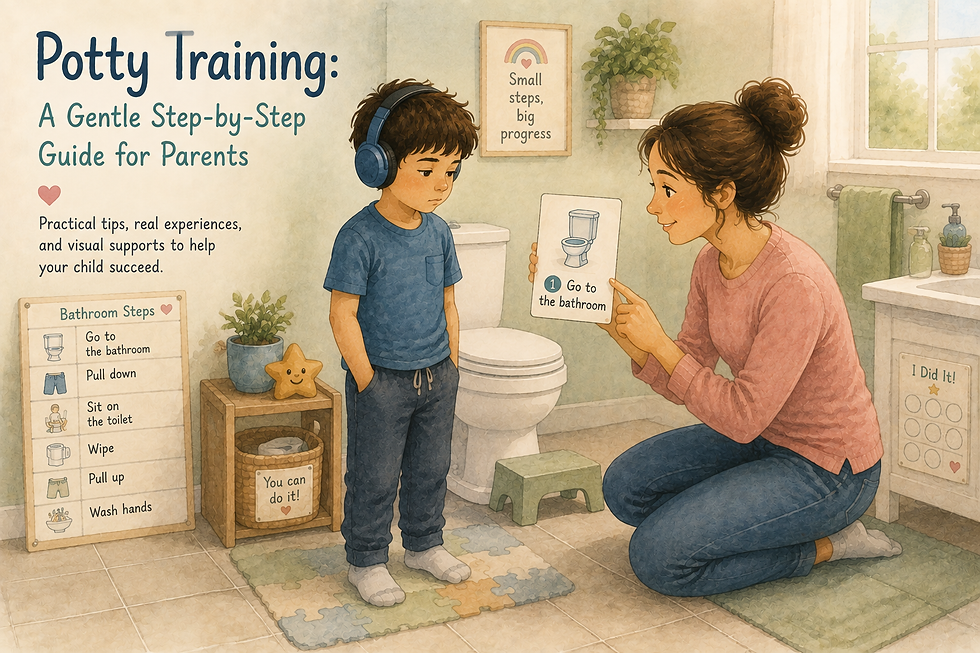
A personal story from one parent to another
Potty training an autistic child may take more time, consistency, and patience, especially when communication or sensory differences are involved. For our family, creating a predictable routine, watching my son's toileting patterns, using simple steps, and staying calm through accidents helped him gradually learn to use the bathroom independently.
When my son was diagnosed with autism, our world changed overnight. Like many parents, I felt overwhelmed. There was so much information, so many therapies, and so many questions about the future.
A few weeks later, we met with an occupational therapist. During our first meeting, she asked me a simple question:
"What are the three biggest goals you want to achieve with your son?"
Without hesitation, I answered:
Communication
Better sleep
Potty training
She smiled and gently laughed.
Then she said something that completely surprised me.
"Those are the three goals every family tells me. But we're probably talking about three or four years from now—not right now."
I remember sitting there feeling shocked.
Three or four years?
As a parent, that felt like forever.
At that moment, I realized that this journey would require patience, persistence, and hope.
When Should You Start Potty Training an Autistic Child?
Around that time, I discovered Dr. Mary Barbera, a well-known autism educator whose practical advice inspired me to look at things differently.
One message stayed with me.
She explained that before starting kindergarten or school, three important life skills can make a huge difference:
Being toilet trained
Asking for food or drink
Washing hands independently
When she explained why asking for food is so important, it made perfect sense.
If a child can communicate basic needs like hunger, thirst, or needing the toilet, everyday life becomes much easier—not only for the child but also for teachers, caregivers, and family members.
That advice gave me hope.
Instead of waiting years because someone told me it wasn't the right time, I decided to start working toward potty training.
How We Started Potty Training Our Autistic Son
I knew this wasn't something I could do halfway.
So before we started, I made sure I wasn't planning any holidays, moving house, or beginning any major projects.
I wanted to give my son my full attention.
Looking back, this was one of the best decisions I made.
I also chose to use a potty chair first because it felt less intimidating.
If I could go back, I might have introduced the toilet earlier, but every child is different. Some children do very well starting directly with the toilet, while others feel safer beginning with a potty.
There isn't one perfect way.
The most important thing is consistency.
Potty or Toilet: Which Is Better for an Autistic Child?
We started with a potty because it felt smaller and less intimidating for my son. Looking back, I might have introduced the toilet earlier.
I don't think there is one answer that works for every autistic child. Some children may feel more comfortable starting with a potty, while others may manage the toilet with a child seat and step stool.
The important thing is choosing an option your child can tolerate and then keeping the routine as predictable as possible.
Create a Consistent Potty Training Routine
Potty training isn't just about teaching your child.
It's about creating space in your own life for learning together.
Before each day began, I tried to:
Prepare meals in advance.
Finish household chores early.
Keep my schedule as clear as possible.
That way, I could focus completely on my son.
I watched carefully for signs that he needed to wee or poo.
I noticed the times of day he usually went.
I learned his body language.
I celebrated every tiny success.
What If My Autistic Child Keeps Having Potty Training Accidents?
Yes...
There will be accidents.
Lots of them.
There will be wet clothes.
There will be messes to clean up.
Some days will feel like no progress is happening at all.
That is completely normal.
Every accident is another learning opportunity.
Stay calm.
Clean up together.
Then try again.
How Long Can Potty Training Take for an Autistic Child?
After several months—around three to six months in our case—something wonderful happened.
My son started walking to the bathroom by himself when he needed to wee.
It wasn't perfect.
But it was progress.
And progress is worth celebrating.
What If My Autistic Child Will Wee but Won't Poop in the Toilet?
Pooping in the toilet can be especially difficult for some autistic children. There can be many reasons. The feeling may be unfamiliar or uncomfortable, your child may feel anxious or frightened, or constipation may make going to the toilet painful.
Sometimes we don't immediately know what is making it difficult, especially when our child cannot yet explain what they are feeling.
Try to watch for patterns and signs of discomfort, and give your child time. If you notice that your child seems to be in pain, regularly holds their poo, or is struggling with constipation, it's a good idea to speak with their healthcare professional.
If this is your family's experience, please know that you are not alone.
Because this topic is so important and deserves more attention than just a few paragraphs I will be writing a dedicated article about poop training, along with a separate visual printable designed specifically to help families through that stage.
Can Visual Supports Help With Autism Potty Training?
Some autistic children understand routines more easily when they can see what is going to happen rather than relying only on spoken instructions.
A simple toilet visual can break the routine into small steps such as:
Go to the bathroom → Pull pants down → Sit → Wipe → Flush → Wash hands
Visuals can also help make the routine more predictable, particularly for children who have limited spoken language or find transitions difficult.
This is one reason I created our free potty training visual cards—to give parents a simple visual routine they can try at home.
What I Learned From Potty Training My Autistic Son
If you're reading this because you're feeling overwhelmed, I want you to know something.
I have been where you are.
I know how exhausting it can feel.
I know the doubts.
I know the tears.
But I also know the joy of seeing your child achieve something you once thought might never happen.
Every child learns at their own pace.
Don't compare your child to anyone else.
Celebrate every small step.
Because one day, you'll look back and realize just how far you've both come.
Free Autism Potty Training Visual Schedule & Kit
Help your child learn each toilet step with simple visual supports designed especially for autistic children.
Included in this free download:
✅ Toilet Routine Cards
✅ First–Then Board
✅ Reward Chart
✅ Parent Quick Guide
Continue Your Journey
Every child experiences the world in their own unique way, and every family learns along the way.
If this article helped you, you might also enjoy:
Explore Our Free Autism Resources
At AutismPlusMe, we're creating practical guides, visual supports, and free printable resources to make everyday life a little easier one small step at a time.
Our growing resource library includes:
Communication Cards
Morning & Evening Routine Charts
First–Then Boards
Feelings & Emotion Cards
Reward Charts
Potty Training Visual Cards
School Visual Supports
Thank you for being here. We hope AutismPlusMe helps you feel supported, encouraged, and never alone on this journey.
About the Author
This guide was written by a parent who has experienced the challenges of raising an autistic child. At AutismPlusMe, we share practical advice, personal experiences, and free resources to help other families feel supported every step of the way.
Tags
AutismPlusMe • Autism Potty Training • Toilet Training • Autism Parenting • Visual Supports • Autism Printable • Daily Living Skills • Autism Resources • Child Development


Comments