
What Are the Early Signs of Autism in Toddlers? What We Noticed in Our Son

Updated: Aug 15
Before my son was diagnosed with autism, I kept telling myself that every child develops differently.
People reassured me that boys often talk later.
That he would catch up.
That I was worrying too much.
But deep down, I knew something felt different.
It wasn't one big sign.
It was dozens of little moments that slowly came together like pieces of a puzzle.
Looking back now, those early signs helped us begin the journey that eventually led to the support he needed.
If you're wondering whether your child might be showing early signs of autism, I hope our family's story helps you feel a little less alone.
What Are the Early Signs of Autism in Toddlers?
Early signs of autism in toddlers can appear in the way a child communicates, plays, interacts with other people, or responds to the world around them.
Some parents may notice things such as a child not consistently responding to their name, rarely pointing to share interest, differences in speech or communication, repetitive ways of playing, or strong reactions to certain sounds or changes in routine.
However, one sign by itself does not mean that a child is autistic. Every child develops differently, and autism can look very different from one child to another.
If you are concerned about your child's development, it's a good idea to discuss what you're noticing with a qualified healthcare professiona
Do All Autistic Toddlers Show the Same Signs?
One of the most important things I've learned is that autism doesn't look the same in every child.
Some children speak early.
Others don't.
Some love being around people.
Others prefer to play alone.
There isn't a checklist that fits every child.
Instead, it's often a collection of small differences that gradually become more noticeable over time.
Parent Tip : Trust your instincts. You know your child better than anyone else.
If something doesn't feel quite right, it's okay to ask questions.

What Early Signs of Autism Did We Notice in Our Son?
For us, it wasn't one dramatic moment.
It was lots of little things.
Our son rarely pointed to show us interesting things.
He didn't always respond when we called his name.
He became upset by certain sounds.
Changes to his routine could completely overwhelm him.
He preferred spinning objects or watching things move instead of joining pretend play.
Each sign on its own didn't seem unusual.
Together, they began telling a story.
Parent Tip :Write down the things you notice. Small observations over several weeks are often more helpful than trying to remember everything later.

Can a Child Be Autistic and Still Make Eye Contact or Enjoy Hugs?
Some autistic children speak early.
Others don't speak at all.
Some enjoy hugs.
Others avoid touch.
Some make eye contact.
Others communicate in completely different ways.
Autism isn't defined by one behavior.
It's about understanding how your child experiences the world.
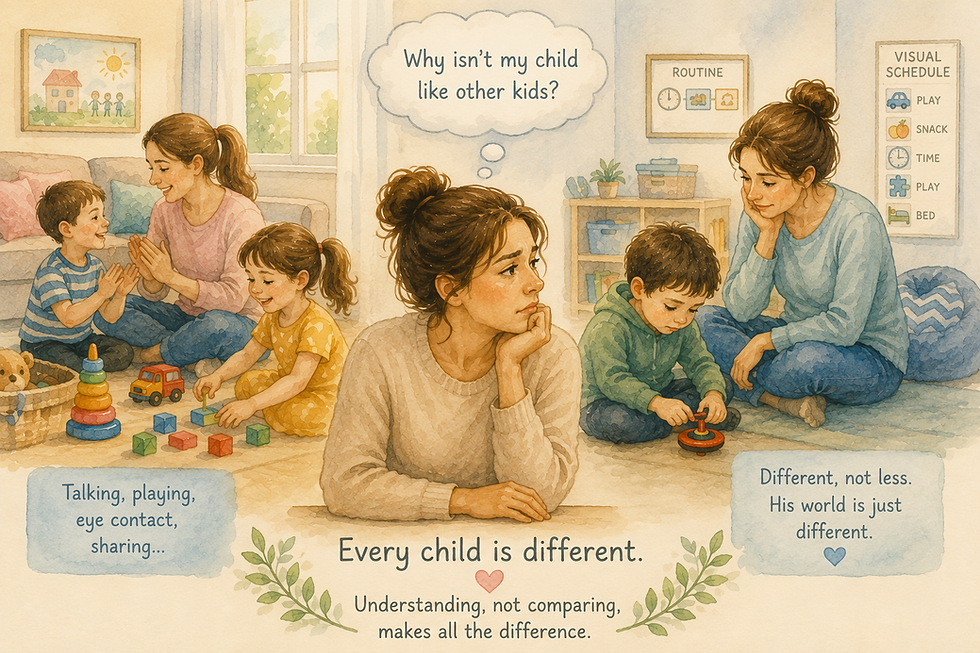
Comparing children rarely helps.
Understanding your own child does.
Parent Tip :Try not to compare your child to siblings or friends.
Celebrate your child's own progress, no matter how small.
Can a Toddler Lose Words or Skills They Previously Had?
Sometimes the signs of autism are noticeable very early. In other children, parents may notice something different: their child begins to lose skills they previously had.
This is often called developmental regression.
A child may stop using words they previously used, communicate less than before, lose some social or play skills, or seem less interested in interacting with other people.
This was not part of our son's story, but I think it is important to mention because every family's experience is different.
If you notice that your child has lost words, communication, social skills, or other abilities they previously had, speak with a healthcare professional rather than waiting to see if those skills return.
When Should You Ask for an Autism Assessment?
If you have a feeling that something about your child's development isn't quite right, don't ignore it.
Trust your instincts.
As parents, we spend so much time with our children that we often notice small changes and differences before anyone else does.
You might notice differences in your child's communication, play, social interaction, response to their name, sensory reactions, or ability to cope with changes. You may also notice that your child has lost words or skills they previously had.
You don't have to be 100% certain that your child is autistic before asking for help. If you are concerned about their development, talk to a healthcare professional and explain what you have been noticing.
For me, getting an assessment felt frightening.
Part of me worried that my fears would be confirmed. Another part hoped that everything would simply improve with time.
I remember feeling that way very clearly.
Sometimes one parent notices the signs before the other. Your partner may not be ready to see what you're seeing, and that's okay.
Try not to let it become a battle.
People process worries about their child's development differently. One parent may want answers immediately, while another may need more time.
For us, getting an assessment wasn't about giving up.
It was about finding answers.
A diagnosis doesn't change who your child is. Your child is still the same child they were the day before.
For our family, having answers helped us better understand our son's needs and begin finding the support that was right for him.
Looking back now, I only wish I had trusted my instincts sooner.
Parent Tip: If you're worried, you don't have to wait until you're "100% sure." Write down the things you're noticing and discuss them with a healthcare professional. Asking for an assessment is
simply a step toward better understanding your child's development.

What Should I Do If I Notice Early Signs of Autism?
Looking back, I don't remember one single moment that told me my son was autistic.
I remember hundreds of tiny moments.
Each one seemed small on its own.
Together, they helped us understand how differently he experienced the world.
If you're beginning this journey yourself, remember this:
You don't have to have all the answers today.
You only need to take the next small step.
And sometimes, asking for help is that step.
If you're concerned about your child's development, write down what you're noticing and discuss it with your child's healthcare professional. Asking questions is simply a step toward understanding what support, if any, your child may need.
Continue Your Autism Journey
Every child experiences the world in their own unique way, and every family learns along the way.
If this article helped you, you might also enjoy:
At AutismPlusMe, we're creating practical guides, visual supports, and printable resources to make everyday life a little easier one small step at a time.


Comments